
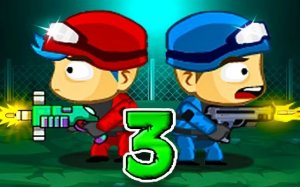
Allied Creature Ward 3
Reviews
Allied Creature Ward 3 targets groups who want a shared-screen defense challenge rather than a solo grind. Its strengths are the enforced role split across three keyboard layouts, the tactical choice between healing and slowing webs, and ten waves that shift creature types to prevent repetition. The limitation is built into the design: it needs three people in the same room, and the mouse-driven tools may favor whichever player holds it. Communication skills matter as much as strategy.
About this game
Three Roles, One Keyboard
Allied Creature Ward 3 is built for three people sharing a single computer, and the control scheme reflects that directly. Player one moves with WASD, player two uses the arrow keys, and player three relies on a separate letter cluster. The mouse handles tool and power-up activation. This split means no one can quietly carry the team; each person's movement is physically tied to their own part of the keyboard. The game asks groups to decide early who manages creatures, who runs support, and who places defensive structures, then adjust those assignments as pressure increases.
Medics and Slowing Webs
Two additions shape how this installment plays compared to a standard defense setup. Medic characters can restore health to teammates, which gives a group room to recover from a bad placement or a missed creature. Web-based slowing mechanisms reduce creature movement speed when placed on the battlefield, buying time to reposition or focus fire. Neither tool activates on its own. Deciding when to heal versus when to lay a web is a recurring judgment call, and wasting either at the wrong moment leaves the team exposed during the next wave.
Ten Waves of Rising Pressure
The structure runs through ten waves, each more demanding than the last. Early rounds give players space to learn controls and settle their defensive layout. Later waves shift creature types, which forces teams to reposition defenses or change their focus rather than repeat a working pattern. Because the difficulty climbs and creature composition changes, two groups rarely solve the game the same way. Success depends on communication and shared responsibility more than individual reflexes.
Planning Over Reflexes
Winning in Allied Creature Ward 3 rewards foresight. Where defenses go, when slowing webs drop, and how safely medics stay positioned all matter more than fast clicking. The cooperative design means strategies vary widely between groups, and trying different role splits or defensive layouts adds replay value. The controls take a few minutes to learn, but once the three-keyboard layout becomes familiar, the real challenge is coordinating decisions under time pressure.


Comments
0 comments